


CVE-2026-1490
Spam protection, Honeypot, Anti-Spam by CleanTalk <= 6.71 - Authorization Bypass via Reverse DNS (PTR record) Spoofing to Unauthenticated Arbitrary Plugin Installation
Description
The Spam protection, Anti-Spam, FireWall by CleanTalk plugin for WordPress is vulnerable to unauthorized Arbitrary Plugin Installation due to an authorization bypass via reverse DNS (PTR record) spoofing on the 'checkWithoutToken' function in all versions up to, and including, 6.71. This makes it possible for unauthenticated attackers to install and activate arbitrary plugins which can be leveraged to achieve remote code execution if another vulnerable plugin is installed and activated. Note: This is only exploitable on sites with an invalid API key.
INFO
Published Date :
Feb. 15, 2026, 4:15 a.m.
Last Modified :
June 17, 2026, 10:15 a.m.
Remotely Exploit :
Yes !
Source :
[email protected]
Affected Products
The following products are affected by CVE-2026-1490
vulnerability.
Even if cvefeed.io is aware of the exact versions of the
products
that
are
affected, the information is not represented in the table below.
CVSS Scores
| Score | Version | Severity | Vector | Exploitability Score | Impact Score | Source |
|---|---|---|---|---|---|---|
| CVSS | 134c704f-9b21-4f2e-91b3-4a467353bcc0 | |||||
| CVSS 3.1 | CRITICAL | [email protected] |
Solution
- Update the CleanTalk plugin to version 6.72 or later.
- Verify API key validity and configuration.
- Monitor for unauthorized plugin installations.
Public PoC/Exploit Available at Github
CVE-2026-1490 has a 1 public
PoC/Exploit available at Github.
Go to the Public Exploits tab to see the list.
References to Advisories, Solutions, and Tools
Here, you will find a curated list of external links that provide in-depth
information, practical solutions, and valuable tools related to
CVE-2026-1490.
CWE - Common Weakness Enumeration
While CVE identifies
specific instances of vulnerabilities, CWE categorizes the common flaws or
weaknesses that can lead to vulnerabilities. CVE-2026-1490 is
associated with the following CWEs:
Common Attack Pattern Enumeration and Classification (CAPEC)
Common Attack Pattern Enumeration and Classification
(CAPEC)
stores attack patterns, which are descriptions of the common attributes and
approaches employed by adversaries to exploit the CVE-2026-1490
weaknesses.
We scan GitHub repositories to detect new proof-of-concept exploits. Following list is a collection of public exploits and proof-of-concepts, which have been published on GitHub (sorted by the most recently updated).

None
Results are limited to the first 15 repositories due to potential performance issues.
The following list is the news that have been mention
CVE-2026-1490 vulnerability anywhere in the article.

-
 The Cyber Express
4 in 5 Singapore Business Websites Have WordPress Vulnerabilities
A new Singapore Study has found that four in five websites run by local businesses carry at least one detectable WordPress vulnerabilities. The Singapore WordPress Website Cybersecurity Study, release ... Read more

-
The Cyber Express
Hackers Exploit Kali Forms Vulnerability to Take Over WordPress Sites
A recently disclosed Kali Forms vulnerability affecting a widely used WordPress plugin has escalated into an active security threat, enabling unauthenticated attackers to achieve Remote Code Execution ... Read more

-
The Cyber Express
Marquis Accuses SonicWall of Security Lapses; Ties it to Ransomware Attack
A legal dispute is intensifying in Texas as fintech firm Marquis sues its firewall provider, SonicWall, alleging that security failures within the company’s cloud backup service directly contributed t ... Read more
-
The Cyber Express
Critical Security Flaws Discovered in Four VS Code Extensions Affecting Millions
Researchers have uncovered vulnerabilities in four widely used VS Code extensions, collectively installed more than 125 million times, raising renewed concerns about the security of the modern softwar ... Read more

-
The Cyber Express
Mozilla Firefox Issues Emergency Patch for Heap Buffer Overflow in Firefox v147
Mozilla has released an out-of-band security update to address a critical vulnerability affecting its browser. The update, issued as Firefox v147.0.4, resolves a high-impact Heap buffer overflow flaw ... Read more

-
The Cyber Express
Attackers Deploy Dormant Backdoors in Ivanti EPMM to Bypass Patching of Latest 0-Days
Threat actors weaponized two Ivanti zero-days so quickly that security teams discovered web shells already installed on servers—using arithmetic expansion in bash scripts to slip past authentication e ... Read more

-
The Cyber Express
Zero-Day in Dell RecoverPoint Exploited by Chinese Hacker Group
A critical zero-day vulnerability, tracked as CVE-2026-22769, is being actively exploited in Dell Technologies’ RecoverPoint for Virtual Machines. According to Mandiant and Google Threat Intelligence ... Read more

-
The Cyber Express
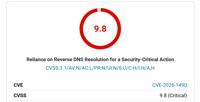
CleanTalk WordPress Plugin Vulnerability Puts 200,000 Sites at Risk
A WordPress plugin vulnerability has placed as many as 200,000 websites at potential risk, following the disclosure of a severe flaw in the CleanTalk Anti-Spam plugin. The issue, tracked as CVE-2026-1 ... Read more
-
 Daily CyberSecurity
200k Sites Exposed: Critical CleanTalk Flaw (CVSS 9.8) Allows RCE
A plugin designed to keep spam bots at bay has inadvertently left the back door open for hackers. CleanTalk, a top-rated anti-spam solution for WordPress with over 200,000 active installations, has pa ... Read more
The following table lists the changes that have been made to the
CVE-2026-1490 vulnerability over time.
Vulnerability history details can be useful for understanding the evolution of a vulnerability, and for identifying the most recent changes that may impact the vulnerability's severity, exploitability, or other characteristics.
-
CVE Modified by [email protected]
Jun. 17, 2026
Action Type Old Value New Value Added Affected [{'vendor': 'cleantalk', 'product': 'Spam protection, Honeypot, Anti-Spam by CleanTalk', 'versions': [{'status': 'affected', 'version': '0', 'versionType': 'semver', 'lessThanOrEqual': '6.71'}], 'defaultStatus': 'unaffected'}] -
CVE Modified by 134c704f-9b21-4f2e-91b3-4a467353bcc0
Jun. 17, 2026
Action Type Old Value New Value Added SSVC {'id': 'CVE-2026-1490', 'role': 'CISA Coordinator', 'options': [{'exploitation': 'none'}, {'automatable': 'yes'}, {'technicalImpact': 'total'}], 'version': '2.0.3', 'timestamp': '2026-02-17T21:21:41.509756Z'} -
New CVE Received by [email protected]
Feb. 15, 2026
Action Type Old Value New Value Added Description The Spam protection, Anti-Spam, FireWall by CleanTalk plugin for WordPress is vulnerable to unauthorized Arbitrary Plugin Installation due to an authorization bypass via reverse DNS (PTR record) spoofing on the 'checkWithoutToken' function in all versions up to, and including, 6.71. This makes it possible for unauthenticated attackers to install and activate arbitrary plugins which can be leveraged to achieve remote code execution if another vulnerable plugin is installed and activated. Note: This is only exploitable on sites with an invalid API key. Added CVSS V3.1 AV:N/AC:L/PR:N/UI:N/S:U/C:H/I:H/A:H Added CWE CWE-350 Added Reference https://plugins.trac.wordpress.org/browser/cleantalk-spam-protect/trunk/lib/Cleantalk/ApbctWP/RemoteCalls.php#L69 Added Reference https://plugins.trac.wordpress.org/browser/cleantalk-spam-protect/trunk/lib/Cleantalk/Common/Helper.php#L64 Added Reference https://plugins.trac.wordpress.org/changeset/3454488/cleantalk-spam-protect#file473 Added Reference https://www.wordfence.com/threat-intel/vulnerabilities/id/cb603be6-4a12-49e1-b8cc-b2062eb97f16?source=cve