


CVE-2026-34183
Unbounded Memory Growth in the QUIC PATH_CHALLENGE Handler
Description
Issue summary: Remote peer may exhaust heap memory of the QUIC server or client by flooding it with packets containing PATH_CHALLENGE frames. Impact summary: A malicious remote peer can cause an unbounded memory allocation which can lead to an abnormal termination of the application acting as a QUIC client or server and a Denial of Service. A remote peer may exhaust heap memory by flooding the local QUIC stack with PATH_CHALLENGE frames. The local QUIC stack allocates a PATH_RESPONSE frame for every PATH_CHALLENGE it receives. The allocated PATH_RESPONSE frame gets freed only when the remote peer acknowledges reception of the PATH_RESPONSE frame which will not be done by a malicious peer. The FIPS modules in 4.0, 3.6, 3.5, 3.4, and 3.0 are not affected by this issue. The QUIC stack is outside of OpenSSL FIPS module boundary.
INFO
Published Date :
June 9, 2026, 5:17 p.m.
Last Modified :
July 23, 2026, 8:10 a.m.
Remotely Exploit :
Yes !
Source :
[email protected]
CVSS Scores
| Score | Version | Severity | Vector | Exploitability Score | Impact Score | Source |
|---|---|---|---|---|---|---|
| CVSS | 134c704f-9b21-4f2e-91b3-4a467353bcc0 | |||||
| CVSS 3.1 | HIGH | 134c704f-9b21-4f2e-91b3-4a467353bcc0 |
Solution
- Update the QUIC server or client software.
- Apply relevant security patches promptly.
- Monitor network traffic for suspicious activity.
Public PoC/Exploit Available at Github
CVE-2026-34183 has a 1 public
PoC/Exploit available at Github.
Go to the Public Exploits tab to see the list.
References to Advisories, Solutions, and Tools
Here, you will find a curated list of external links that provide in-depth
information, practical solutions, and valuable tools related to
CVE-2026-34183.
CWE - Common Weakness Enumeration
While CVE identifies
specific instances of vulnerabilities, CWE categorizes the common flaws or
weaknesses that can lead to vulnerabilities. CVE-2026-34183 is
associated with the following CWEs:
Common Attack Pattern Enumeration and Classification (CAPEC)
Common Attack Pattern Enumeration and Classification
(CAPEC)
stores attack patterns, which are descriptions of the common attributes and
approaches employed by adversaries to exploit the CVE-2026-34183
weaknesses.
We scan GitHub repositories to detect new proof-of-concept exploits. Following list is a collection of public exploits and proof-of-concepts, which have been published on GitHub (sorted by the most recently updated).

None
Dockerfile
Results are limited to the first 15 repositories due to potential performance issues.
The following list is the news that have been mention
CVE-2026-34183 vulnerability anywhere in the article.
-
 The Hacker News
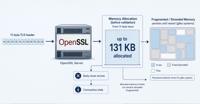
OpenSSL HollowByte Flaw Could Freeze Server Memory with 11-Byte TLS Requests
Eleven bytes will make an unpatched OpenSSL server set aside up to 131 KB of memory for a message that never arrives. On the glibc systems Okta tested, that memory is gone until the process restarts. ... Read more
The following table lists the changes that have been made to the
CVE-2026-34183 vulnerability over time.
Vulnerability history details can be useful for understanding the evolution of a vulnerability, and for identifying the most recent changes that may impact the vulnerability's severity, exploitability, or other characteristics.
-
CVE Translated by [email protected]
Jul. 23, 2026
Action Type Old Value New Value Added Translation Title: OpenSSL, Description: Resumen del problema: Un par remoto puede agotar la memoria del montón del servidor o cliente QUIC inundándolo con paquetes que contienen tramas PATH_CHALLENGE. Resumen del impacto: Un par remoto malicioso puede causar una asignación de memoria ilimitada que puede llevar a una terminación anormal de la aplicación que actúa como cliente o servidor QUIC y a una denegación de servicio. Un par remoto puede agotar la memoria del montón inundando la pila QUIC local con tramas PATH_CHALLENGE. La pila QUIC local asigna una trama PATH_RESPONSE por cada PATH_CHALLENGE que recibe. La trama PATH_RESPONSE asignada se libera solo cuando el par remoto acusa recibo de la trama PATH_RESPONSE, lo cual no será hecho por un par malicioso. Los módulos FIPS en 4.0, 3.6, 3.5, 3.4 y 3.0 no se ven afectados por este problema. La pila QUIC está fuera del límite del módulo FIPS de OpenSSL. -
CVE Modified by [email protected]
Jun. 17, 2026
Action Type Old Value New Value Added Affected [{'vendor': 'OpenSSL', 'product': 'OpenSSL', 'versions': [{'status': 'affected', 'version': '4.0.0', 'lessThan': '4.0.1', 'versionType': 'semver'}, {'status': 'affected', 'version': '3.6.0', 'lessThan': '3.6.3', 'versionType': 'semver'}, {'status': 'affected', 'version': '3.5.0', 'lessThan': '3.5.7', 'versionType': 'semver'}, {'status': 'affected', 'version': '3.4.0', 'lessThan': '3.4.6', 'versionType': 'semver'}], 'defaultStatus': 'unaffected'}] -
CVE Modified by 134c704f-9b21-4f2e-91b3-4a467353bcc0
Jun. 17, 2026
Action Type Old Value New Value Added SSVC {'id': 'CVE-2026-34183', 'role': 'CISA Coordinator', 'options': [{'exploitation': 'none'}, {'automatable': 'yes'}, {'technicalImpact': 'partial'}], 'version': '2.0.3', 'timestamp': '2026-06-10T15:50:50.340971Z'} -
Initial Analysis by [email protected]
Jun. 15, 2026
Action Type Old Value New Value Added CPE Configuration OR *cpe:2.3:a:openssl:openssl:*:*:*:*:*:*:*:* versions from (including) 3.4.0 up to (excluding) 3.4.6 *cpe:2.3:a:openssl:openssl:*:*:*:*:*:*:*:* versions from (including) 3.5.0 up to (excluding) 3.5.7 *cpe:2.3:a:openssl:openssl:*:*:*:*:*:*:*:* versions from (including) 3.6.0 up to (excluding) 3.6.3 *cpe:2.3:a:openssl:openssl:4.0.0:-:*:*:*:*:*:* Added Reference Type OpenSSL Software Foundation: https://github.com/openssl/openssl/commit/5b306efb0b3779dfdd0803b4afc9d08c91f11517 Types: Patch Added Reference Type OpenSSL Software Foundation: https://github.com/openssl/openssl/commit/7d06955ebe0ecf8adfd4c1e92018586da47ef9ac Types: Patch Added Reference Type OpenSSL Software Foundation: https://github.com/openssl/openssl/commit/d2e9efbe4900a373227deb136e8665401404ffac Types: Patch Added Reference Type OpenSSL Software Foundation: https://github.com/openssl/openssl/commit/fbaa83859c01ad64f497b757aaf51be7d05ed9eb Types: Patch Added Reference Type OpenSSL Software Foundation: https://openssl-library.org/news/secadv/20260609.txt Types: Vendor Advisory -
CVE Modified by 134c704f-9b21-4f2e-91b3-4a467353bcc0
Jun. 10, 2026
Action Type Old Value New Value Added CVSS V3.1 AV:N/AC:L/PR:N/UI:N/S:U/C:N/I:N/A:H -
CVE Modified by [email protected]
Jun. 10, 2026
Action Type Old Value New Value Added Reference https://github.com/openssl/openssl/commit/5b306efb0b3779dfdd0803b4afc9d08c91f11517 Added Reference https://github.com/openssl/openssl/commit/7d06955ebe0ecf8adfd4c1e92018586da47ef9ac Added Reference https://github.com/openssl/openssl/commit/d2e9efbe4900a373227deb136e8665401404ffac Added Reference https://github.com/openssl/openssl/commit/fbaa83859c01ad64f497b757aaf51be7d05ed9eb Removed Reference https://github.com/openssl/security/commit/5b306efb0b3779dfdd0803b4afc9d08c91f11517 Removed Reference https://github.com/openssl/security/commit/7d06955ebe0ecf8adfd4c1e92018586da47ef9ac Removed Reference https://github.com/openssl/security/commit/d2e9efbe4900a373227deb136e8665401404ffac Removed Reference https://github.com/openssl/security/commit/fbaa83859c01ad64f497b757aaf51be7d05ed9eb -
New CVE Received by [email protected]
Jun. 09, 2026
Action Type Old Value New Value Added Description Issue summary: Remote peer may exhaust heap memory of the QUIC server or client by flooding it with packets containing PATH_CHALLENGE frames. Impact summary: A malicious remote peer can cause an unbounded memory allocation which can lead to an abnormal termination of the application acting as a QUIC client or server and a Denial of Service. A remote peer may exhaust heap memory by flooding the local QUIC stack with PATH_CHALLENGE frames. The local QUIC stack allocates a PATH_RESPONSE frame for every PATH_CHALLENGE it receives. The allocated PATH_RESPONSE frame gets freed only when the remote peer acknowledges reception of the PATH_RESPONSE frame which will not be done by a malicious peer. The FIPS modules in 4.0, 3.6, 3.5, 3.4, and 3.0 are not affected by this issue. The QUIC stack is outside of OpenSSL FIPS module boundary. Added CWE CWE-1325 Added Reference https://github.com/openssl/security/commit/5b306efb0b3779dfdd0803b4afc9d08c91f11517 Added Reference https://github.com/openssl/security/commit/7d06955ebe0ecf8adfd4c1e92018586da47ef9ac Added Reference https://github.com/openssl/security/commit/d2e9efbe4900a373227deb136e8665401404ffac Added Reference https://github.com/openssl/security/commit/fbaa83859c01ad64f497b757aaf51be7d05ed9eb Added Reference https://openssl-library.org/news/secadv/20260609.txt