


CVE-2026-99312
KVM: x86: Unconditionally reset MMU context when emulating INIT
Description
In the Linux kernel, the following vulnerability has been resolved: KVM: x86: Unconditionally reset MMU context when emulating INIT Force an MMU reset when emulating an INIT even if paging was already disabled, as the MMU page role includes guest_mode (L2), i.e. an INIT while L2 is running with CR0.PG=0 will result in KVM running L1 with a stale MMU context. Alternatively, the reset could be scoped strictly to paging being enabled or L2 being active, but SMM is also encoded in the page role. Even though it _should_ be impossible for the vCPU to be INIT'd while SMM is active, there's zero value in not handling SMM. At that point, the only scenario where KVM _doesn't_ need to reset the MMU context is on an INIT with the vCPU running in Real Mode or Unpaged Protect Mode, and while INIT in those modes is somewhat common, it's far from a hot path and re-initializing the MMU is not expensive, especially when the role isn't changing (KVM elides most of the re-configuration in that case). Note, like the Fixes commit, this bug only affects nested SVM as INIT is an unconditional intercept on VMX, i.e. it's impossible to emulate INIT while L2 is active. Temporarily keep the guest TLB flush when CR0.PG is being cleared even though it is fully redundant with the flush that is emitted on all INIT events (KVM itself only does RESET when a vCPU is being created, i.e. when CR0.PG must be '0').
INFO
Published Date :
Nov. 18, 2026, 9:17 a.m.
Last Modified :
Nov. 19, 2026, 2:17 p.m.
Remotely Exploit :
No
Source :
416baaa9-dc9f-4396-8d5f-8c081fb06d67
CVSS Scores
| Score | Version | Severity | Vector | Exploitability Score | Impact Score | Source |
|---|---|---|---|---|---|---|
| CVSS 3.1 | HIGH | 416baaa9-dc9f-4396-8d5f-8c081fb06d67 |
Solution
- Update the Linux kernel to the latest version.
- Apply necessary patches for KVM MMU context reset.
- Rebuild and deploy the kernel.
References to Advisories, Solutions, and Tools
Here, you will find a curated list of external links that provide in-depth
information, practical solutions, and valuable tools related to
CVE-2026-99312.
CWE - Common Weakness Enumeration
While CVE identifies
specific instances of vulnerabilities, CWE categorizes the common flaws or
weaknesses that can lead to vulnerabilities. CVE-2026-99312 is
associated with the following CWEs:
Common Attack Pattern Enumeration and Classification (CAPEC)
Common Attack Pattern Enumeration and Classification
(CAPEC)
stores attack patterns, which are descriptions of the common attributes and
approaches employed by adversaries to exploit the CVE-2026-99312
weaknesses.
We scan GitHub repositories to detect new proof-of-concept exploits. Following list is a collection of public exploits and proof-of-concepts, which have been published on GitHub (sorted by the most recently updated).
Results are limited to the first 15 repositories due to potential performance issues.
The following list is the news that have been mention
CVE-2026-99312 vulnerability anywhere in the article.
-
 The Hacker News
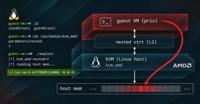
Linux KVM Flaw CVE-2026-99312 Lets Guest VMs Access Host Memory on AMD Hosts
A flaw in KVM, the hypervisor built into the Linux kernel, let researchers read about 127 GB of a cloud server's memory from inside a virtual machine of their own on DigitalOcean. On a shared server, ... Read more
The following table lists the changes that have been made to the
CVE-2026-99312 vulnerability over time.
Vulnerability history details can be useful for understanding the evolution of a vulnerability, and for identifying the most recent changes that may impact the vulnerability's severity, exploitability, or other characteristics.
-
CVE Modified by 416baaa9-dc9f-4396-8d5f-8c081fb06d67
Nov. 19, 2026
Action Type Old Value New Value Added CVSS V3.1 AV:L/AC:L/PR:L/UI:N/S:C/C:H/I:H/A:H -
New CVE Received by 416baaa9-dc9f-4396-8d5f-8c081fb06d67
Nov. 18, 2026
Action Type Old Value New Value Added Description In the Linux kernel, the following vulnerability has been resolved: KVM: x86: Unconditionally reset MMU context when emulating INIT Force an MMU reset when emulating an INIT even if paging was already disabled, as the MMU page role includes guest_mode (L2), i.e. an INIT while L2 is running with CR0.PG=0 will result in KVM running L1 with a stale MMU context. Alternatively, the reset could be scoped strictly to paging being enabled or L2 being active, but SMM is also encoded in the page role. Even though it _should_ be impossible for the vCPU to be INIT'd while SMM is active, there's zero value in not handling SMM. At that point, the only scenario where KVM _doesn't_ need to reset the MMU context is on an INIT with the vCPU running in Real Mode or Unpaged Protect Mode, and while INIT in those modes is somewhat common, it's far from a hot path and re-initializing the MMU is not expensive, especially when the role isn't changing (KVM elides most of the re-configuration in that case). Note, like the Fixes commit, this bug only affects nested SVM as INIT is an unconditional intercept on VMX, i.e. it's impossible to emulate INIT while L2 is active. Temporarily keep the guest TLB flush when CR0.PG is being cleared even though it is fully redundant with the flush that is emitted on all INIT events (KVM itself only does RESET when a vCPU is being created, i.e. when CR0.PG must be '0'). Added Affected New affected value received. <a href="https://github.com/CVEProject/cvelistV5/blob/main/cves/2026/99xxx/CVE-2026-99312.json">CVE-2026-99312</a> Added Reference https://git.kernel.org/stable/c/24f644ea26c2ebb7b14c3baa2aa92d37fde3095f Added Reference https://git.kernel.org/stable/c/c7c288d178cb0b78d3464a616b16b1aa0b316049 Added Reference https://git.kernel.org/stable/c/d47bae9eb33b3ca0843a0954b7d0cafb354c99b0 Added Reference https://git.kernel.org/stable/c/f55a3e4e08dc004b4bab7c1e9323d7e7e96e266a